 Germany
Hello,
I have a problem which seems related to some other threads, but I think it is different enough to start a new thread.
I'll try to make a long story short:
I have multiseat setup with a server in the living room, which I also use as a client on the same machine.
No problems, no stuttering while watching TV, almost everything is fine.
The problems start when I want to watch TV on a second client while on the server is also TV running.
1. scenario: The second client uses DVB-C card because channel is on same transponder.
In this moment the TV of the client on the server (let's call him first client) freezes, but TV on second client is ok.
When I now change channel on first client then TV is ok here, but TV on second client freezes.
So always one client can watch TV and the other freezes.
2. scenario: The second client uses Analogue card.
In this scenario both clients can watch TV, but have many stutters.
What did I do to solve/debug this problem?
I checked total CPU load in all cases, but it is under 50%.
Memory load and CPU load for MediaPortal and TVServer on server PC is also ok.
Networking load is ok.
I have the folder for all timeshifting files on a seperated HDD.
I tried to have timeshift files for tv cards on different HDD (both IDE-0)
I tried RAMDISK for timeshifting files for both card and I tried it only for DVB-C card.
(Of course with "only" 1 GB the RAMDISK is really not a final solution. I would spend money
for more if I would know that it will solve the problem, but I have Mainboard for DDR-400 RAM
and I anyhow can oly upgrade to 2GB)
I tried to disable frame discard with the file "c:\RelaxTsReaderForBadReception.txt", but
after that I had artifacts AND stutters.
I tried different codecs, but I don't think this is the problem because watch TV for only 1 client is ok.
I tried streaming without using RTSP (<entry name="usertsp">no</entry>).
I tried different numbers and sizes for timeshift files
My conclusion
I think scenario 1 is either a software bug or a problem with my DVB-C card to grab
2 streams on a transponder at the same time.
Perhaps I could avoid it if I set the CAM limit to 1.
I'm quite sure that scenario 2 is some kind of performance problem.
But as mentioned CPU and RAM should be fine, so I put the blame on IO.
When 2 clients are watching TV then 2 TS-Writer streams and 2 TS-Reader streams
access the same HDD at the same time.
But my test to put timeshift buffer for one card on another HDD didn't help.
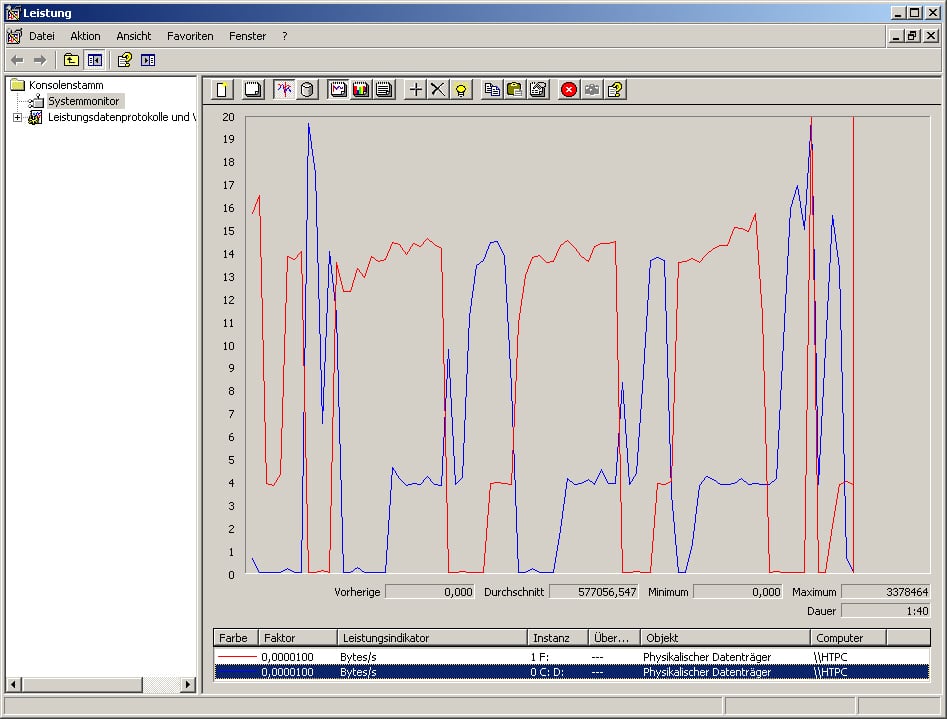
I could see that HDD access load alternates between both HDDs, so probably this
is a evidence that HDD access is the bottleneck (see attached picture).
Could it help to connect one HDD to IDE-0 and one to IDE-1?
What can I do now?
I'm running out of ideas now and really need help.
I would upgrade my system if I would know where the bottleneck is.
What can I test?
Can someone tell me what entries in the logs could be related to this.
There are so many logs with so many entries, so I'm not experienced
enough with this to know what is important.
Thank you very much
Thomas
P.S.: Can anyone tell me why sometimes there are more than 2 timeshift streams for my DVB-C card?
live4-0, live4-1, live4-2...live4-6...
I have only 2 clients and there was no recording. It seems to me that sometime MP does not use the
old timeshift files and always starts a new one after channel change.
TV-Server Version: TV-Server 1.0 RC3 Revision:20755
MediaPortal Version: MediaPortal 1.0 RC3 Revision:20755
MediaPortal Skin: Blue3Wide (Server) & Blue3 (Clients)
Windows Version: XP with SP3 and dvb-hotfix
CPU Type: Athlon 3000+
Memory: 1 GB
1. TV Card Type: DVB-C
2. TV Card Type: Analogue
I have a problem which seems related to some other threads, but I think it is different enough to start a new thread.
I'll try to make a long story short:
I have multiseat setup with a server in the living room, which I also use as a client on the same machine.
No problems, no stuttering while watching TV, almost everything is fine.
The problems start when I want to watch TV on a second client while on the server is also TV running.
1. scenario: The second client uses DVB-C card because channel is on same transponder.
In this moment the TV of the client on the server (let's call him first client) freezes, but TV on second client is ok.
When I now change channel on first client then TV is ok here, but TV on second client freezes.
So always one client can watch TV and the other freezes.
2. scenario: The second client uses Analogue card.
In this scenario both clients can watch TV, but have many stutters.
What did I do to solve/debug this problem?
I checked total CPU load in all cases, but it is under 50%.
Memory load and CPU load for MediaPortal and TVServer on server PC is also ok.
Networking load is ok.
I have the folder for all timeshifting files on a seperated HDD.
I tried to have timeshift files for tv cards on different HDD (both IDE-0)
I tried RAMDISK for timeshifting files for both card and I tried it only for DVB-C card.
(Of course with "only" 1 GB the RAMDISK is really not a final solution. I would spend money
for more if I would know that it will solve the problem, but I have Mainboard for DDR-400 RAM
and I anyhow can oly upgrade to 2GB)
I tried to disable frame discard with the file "c:\RelaxTsReaderForBadReception.txt", but
after that I had artifacts AND stutters.
I tried different codecs, but I don't think this is the problem because watch TV for only 1 client is ok.
I tried streaming without using RTSP (<entry name="usertsp">no</entry>).
I tried different numbers and sizes for timeshift files
My conclusion
I think scenario 1 is either a software bug or a problem with my DVB-C card to grab
2 streams on a transponder at the same time.
Perhaps I could avoid it if I set the CAM limit to 1.
I'm quite sure that scenario 2 is some kind of performance problem.
But as mentioned CPU and RAM should be fine, so I put the blame on IO.
When 2 clients are watching TV then 2 TS-Writer streams and 2 TS-Reader streams
access the same HDD at the same time.
But my test to put timeshift buffer for one card on another HDD didn't help.
I could see that HDD access load alternates between both HDDs, so probably this
is a evidence that HDD access is the bottleneck (see attached picture).
Could it help to connect one HDD to IDE-0 and one to IDE-1?
What can I do now?
I'm running out of ideas now and really need help.
I would upgrade my system if I would know where the bottleneck is.
What can I test?
Can someone tell me what entries in the logs could be related to this.
There are so many logs with so many entries, so I'm not experienced
enough with this to know what is important.
Thank you very much
Thomas
P.S.: Can anyone tell me why sometimes there are more than 2 timeshift streams for my DVB-C card?
live4-0, live4-1, live4-2...live4-6...
I have only 2 clients and there was no recording. It seems to me that sometime MP does not use the
old timeshift files and always starts a new one after channel change.
TV-Server Version: TV-Server 1.0 RC3 Revision:20755
MediaPortal Version: MediaPortal 1.0 RC3 Revision:20755
MediaPortal Skin: Blue3Wide (Server) & Blue3 (Clients)
Windows Version: XP with SP3 and dvb-hotfix
CPU Type: Athlon 3000+
Memory: 1 GB
1. TV Card Type: DVB-C
2. TV Card Type: Analogue